.jpg)
Design
Fundamental design features include:
- 150 word vocabulary
- No prior language training needed
- Gameplay is directly related to language understanding
- Game can be extended with additional language packs (or modified by players)
- Designed for touch interfaces (tablet, multitouch, etc)
- 3 Game Modes
- Standard: Language Orientation
Player navigates through rooms and is quizzed only on words within a specific category. - Incremental: Language Application and Recognition
Players acquires base vocabulary through linear progression. Each time a word is matched, the list of possible words increases. - Timed:Testing
The possible vocabulary increases linearly within a topic, while the chosen word could be in any room. The player is under a time constraint.
Design Goals:
- Provide a general audience with a way to learn basic vocabulary for a planned foreign language immersion (e.g. travel, visiting relatives, etc)
- Improve the experience provided by tools that pursue a similar goal
Basic Design Premise:
- Players learn the terminology of a game play environment to accomplish tasks
- Give the player a set of basic tasks which require understanding of the language
Design Assumptions:
- Casual games are easy for more people to understand
- Simple mechanics, mean fewer layers of learning
- Modular design for multiple languages
- Non- literal – players not distracted by “mis-translation” of real world (e.g. physics, ai)
Research:
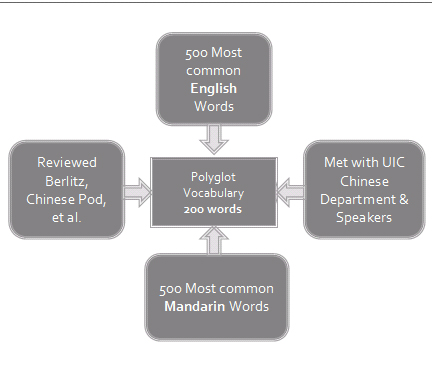
The 500 Most commonly used English words were collected, reviewed and reduced. That list was then matched to words provided by quick langauge gudes, the most commonly used words of the foreign langauge, and information provided by Native speakers and academics.
I designed 150+ pictographs for the Mandarin Chinese version.
Review presentation slides here (.pdf)